
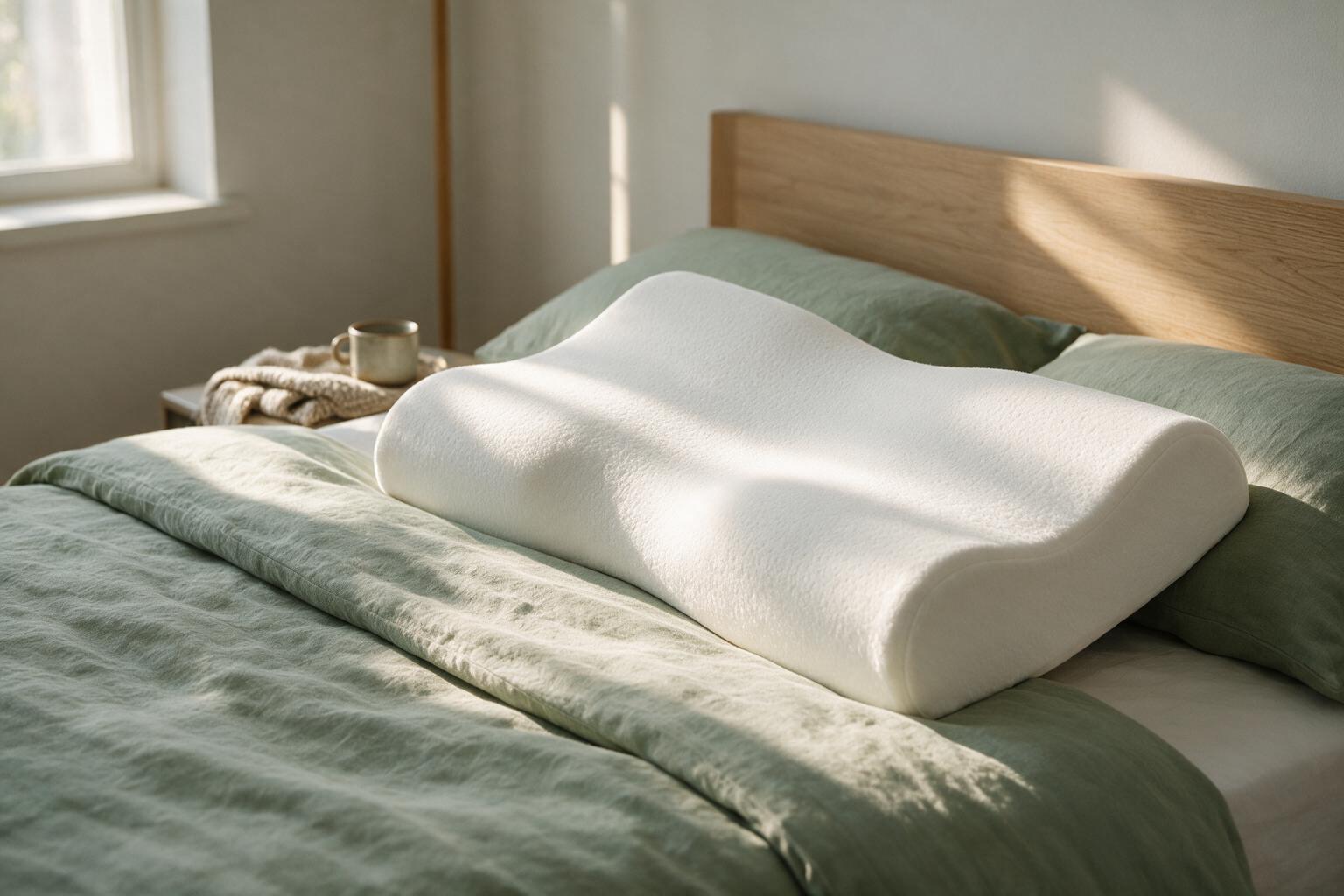
Most people buy a pillow the way they buy a shirt — they pick one that looks about right and hope for the best. But your pillow is doing a very specific mechanical job for eight hours a night, and its dimensions matter far more than its colour or its feel in the shop. Get the size right and you wake up without the dull ache behind your eyes. Get it wrong and no amount of stretching, magnesium or blackout curtains will fully fix it.
Here is how to match a pillow to your body and your sleeping position, and why memory foam gives you the widest margin for error.
Why Pillow Size Is Really About Alignment
Your head weighs somewhere between 4.5 and 5.5 kilograms. Whatever supports it at night determines the angle of your neck relative to your spine for the next several hours. The ideal is a straight line from the base of your neck down through your upper back — what physiotherapists call a neutral spine.
When that line is broken, the muscles along the back of your neck spend the night working instead of resting. You may not notice it at 2 a.m., but you will notice it at 7 a.m. That is why “my pillow is too soft” is rarely the real complaint. The real complaint is usually that the pillow is the wrong height for the way you lie.
The Three Sleeping Positions and What Each One Needs
Side Sleepers: Fill the Gap, Don’t Flatten the Shoulder
Side sleeping is the most common position and the one that needs the tallest pillow. There is a real gap between your ear and the mattress — roughly the width of your own shoulder — and if the pillow collapses into that gap, your head drops below your spine line.
Look for a loft of about 10 to 13 centimetres, firm enough to hold that height through the night. A memory foam pillow works well here because it compresses where your shoulder pushes and stays lifted where your head rests, rather than turning into a flat disc by 3 a.m.
Back Sleepers: A Gentle Curve, Not a Dead Flat
Back sleeping needs a medium loft — think 8 to 10 centimetres, or roughly the height of one fist. The pillow should fill the natural curve at the back of your neck while letting the crown of your head rest slightly lower.
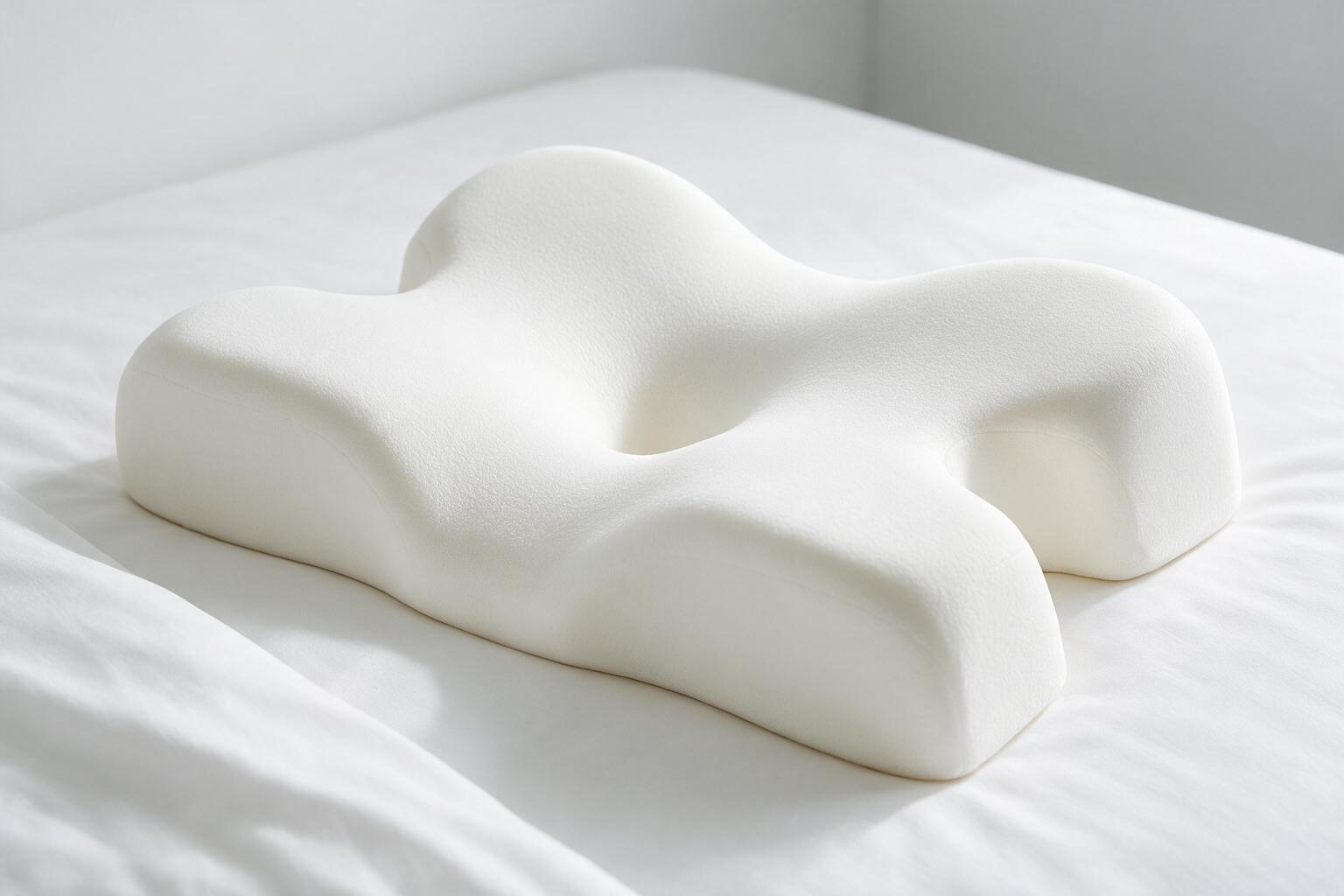
This is where contoured shapes earn their keep. A pillow with a raised neck ridge and a shallow head cradle does that job without you having to adjust it repeatedly during the night.
Stomach Sleepers: Go Thin, or Consider No Pillow At All
If you sleep on your stomach, a tall pillow forces your neck into an extreme turn for hours. Choose the thinnest option available — 5 to 7 centimetres, or a flat profile — and accept that your pillow is mainly there for comfort, not support.
The Body Signals You Should Never Ignore
Rather than guessing, use your mornings as diagnostics:
- Waking with a stiff, aching neck — your pillow is likely too high, pushing your head forward.
- Numbness or tingling in your arms or fingers — often too high, compressing the shoulder area.
- Snoring or a dry mouth in the morning — often too low, allowing your chin to drop and your airway to narrow.
- Headaches that fade an hour after waking — frequently a sign of overnight neck strain from the wrong height.
One bad night tells you nothing. A pattern over two weeks tells you almost everything.
Why Memory Foam Handles Size Differences Better
Traditional fibre pillows are generous at first and progressively less supportive as the filling migrates and compacts. Memory foam behaves differently: it responds to your body’s heat and weight, then recovers slowly, so the support you feel on night one is close to what you feel on night two hundred.
That consistency is what makes a memory foam pillow easier to size correctly in the first place — and much harder to accidentally ruin. Copper-infused foam goes a step further, adding a cooling element that keeps the foam from trapping heat, which is the most common objection people have to memory foam.
A Quick Way to Test Your Current Pillow Tonight
Before you buy anything, try this. Lie on your side with your normal pillow, and have someone take a photo of you from the side, or use your phone’s front camera on a timer. Draw an imaginary line from your forehead down through your chin to your sternum. If that line is roughly straight, your height is right. If your head is tilted up, you need less loft. If it is angled down, you need more.
It takes five minutes and it will save you from buying the same wrong pillow twice.
Build Your Pillow Around Your Body, Not the Bedroom Aesthetic
A pillow is one of the few purchases you can make that affects every single night of the year. Choose the height that matches your sleeping position, stick to a material that holds that height, and give yourself a week or two to adjust before judging the result.
At IDEEComfort, our contoured memory foam pillows are designed with distinct neck and head zones, so the correct alignment is built into the shape rather than left to chance. Explore our range of ergonomic pillows and silicone foam bedding to find the size that fits the way you actually sleep — customized to your needs.